by Kieran Mathieson
School of Business Administration
Oakland University
Rochester, Michigan, USA
Introduction
Few technologies can match the Web in growth and potential. We've already seen a lot of technological change and are in for more. It will be a few years before things like dynamic HTML, video streaming and digital wallets are part of every site, but the trends are there.
Just as interesting are the changes in business relationships encouraged by the Web. Take the relationship between firms and consumers. The Web lets marketers feed customized multimedia content to people around the globe. The cost of transmitting the information is close to zero. The information is available whenever the consumer wants to look at it. Orders can be taken online, right from the consumer's PC. What a dream!
But consumers are not a captive audience on the Web. They choose whether to see content. They're a click away from competitors, information intermediaries like CarPoint, and millions of other consumers ready to share their experiences. For companies relying on control of information channels to push goods to isolated consumers, the Web could be a nightmare.
When linked with databases and logic, the Web is more than a passive information distributor. Amazon.com, for example, presents items it thinks might interest individual consumers based on their past order histories. Because it can remember orders, is searchable and so on, Amazon.com becomes an active decision making tool.
The focus in creating decision support tools for consumers should be on the consumers' goals. If a firm offers a thinly-disguised product brochure as a "decision tool," the savvy consumer will just go elsewhere. He'll also tell 10,000 of his closest friends about it on a newsgroup. If a firm wants to offer decision support tools consumers will value, it has to understand how they make decisions and what they are trying to achieve.
This article gives some ideas for Web support for long purchase decisions. Most consumer purchase decisions are made quickly, often in a few seconds. People don't waste much time choosing soft drink, cereal, gum and other small items. But decisions about cars, houses, dream vacations and so on might take a few days, weeks or even months to make. Someone might get information from the Web, brochures, newspapers, sales people, other consumers and radio shows. Information is sought, filtered, combined, judged and discarded. The final choice could be the result of a lot of research.
Why build Web sites to help with these decisions? There are several reasons. First, they're high-value decisions for consumers (and firms). The consequences of error can be serious. If you buy a bad pack of gum, you throw it away and buy another. If you buy a bad house, you might be stuck. Second, they're the decisions the Web is best at supporting. The Web is about information, and long purchase decisions are information intensive. Other media might get consumers interested in a product. A Web decision support tool can help them prove to themselves that it's the right choice.
It's not clear how much American consumers like to think about big ticket items. Consumers often seem to decide quickly, but appearances can be misleading. Someone might go into a used car lot, test drive three cars, and buy one. That seems like a quick decision. But why that lot? How long was she saving for the down payment? Why those three cars? The seemingly quick choice might actually be the tip of a large decision making iceberg.
The next section examines how people make decisions over time. Then we'll look at some Web site features to support this process. Finally, we'll return to the question: is it worthwhile for a firm to offer these tools?
Making Decisions Over Time
We're interested in situations where:
We're only going to consider situations important and complex enough so that people might actually want Web support. Nobody would build a decision tool to help select Pez flavors. Nothing against Pez, but it's just not important to most people. The last assumption (time, memory and expertise) is a consequence of being human. It's only listed so we don't forget it.
Consumer decision making over time is not fully understood. However, there are some things we can say about it.
Improved Problem Understanding
When consumers buy stuff, they are matching a product to a problem (Mathieson, 1998). Over time, their understanding of the problem should improve. Suppose someone is buying a computer for the first time. They might have some vague ideas about the kids using "that Internet thingy" at the beginning of the processes. When they buy their machine two weeks later, they know about a range of educational applications from encyclopedias to simulations, email and other communication products, games and financial planning software. The consumer has a better understanding of what the PC can do.
The Consideration Set Over Time
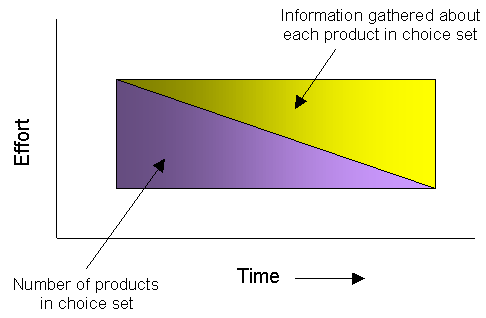
The consideration set is the group of products a consumer is evaluating at any one time. It usually consists of about two to eight products (Ursic and Helgeson, 1990), reducing to one when the consumer makes a choice.
How is this reduction done? The consideration set is a group of brands, each of which has attributes like price and quality. Consumers often start with an attribute-based strategy. They choose one or two key attributes and discard products that don't meet some minimums. When there are just a few brands left, consumers switch to a brand-based strategy. This means evaluating all of the attributes for each brand. They create an overall evaluation for each brand and choose the best one.
Suppose someone is choosing a PC. She knows about Gateway 2000, Micron, Compaq, Dell, Packard Bell and others. She looks at two attributes initially: price and availability through regular retail channels. This narrows her search to Compaq and Packard Bell. She then looks more carefully at these two, examining their CPU, hard drive capacity, monitor, etc.
The amount of mental effort might remain fairly constant over this time.
It just changes focus:
Use of Information Sources
Consumers use information from many sources, including sales reps, brochures, Web sites and friends. The more credible a source is, the more impact it has. Credibility depends on consumers' judgments about two things: expertise and trust. Expertise is about knowledge. Trust depends on whose goals an opinion serves. The consumer asks: "Does this source want to help me get what I want? Or are they really out to help themselves?"
Different information sources are good for different things. Suppose Beaver Cleaver wants to buy a clock for his mother's birthday. He asks Wally and a sales rep what they think about two different clocks, and gets an opinion from both. The sales rep has more expertise about clocks, but less about June's style preferences (June is the Beaver's mother, for you youngsters, and stay out of my yard! Damn kids…). Wally is more trustworthy, since he is interested in helping the Beaver make a good choice.
When it comes to computerized information sources, there's a third variable: ease of use. Wally and the sales rep are intelligent, and can respond to the Beaver's questions. They can volunteer information the Beaver might have missed, as in "Gee, Beav, the color is OK, but the clock's digital. You know they haven't been invented yet."
Information sources like brochures, catalogs and Web sites aren't very smart. Consumers can't ask them questions. Web sites have search engines, but consumers have to know what to search for. Some sites help by, for example, explaining what product attributes people in different market segments usually care about. See Mathieson (1990) for more information. But the consumer still has to do a lot of work.
Over time, consumers learn about the value of different sources for different types of information. They're able to focus information search on appropriate sources. If they find a few good sources, they might just use those. This is the heart of a consumer-firm relationship: if a consumer knows that a firm will help him solve his problems at a reasonable price, why go elsewhere?
Need for Memory
When decisions are spread over time, consumers need to remember:
Suppose the Beaver sees an ad in a magazine for a TempoMaster clock. He thinks "Gee, that looks pretty neat, but I don't know whether Mom would like the triangular case. I'd better ask my wise father tonight." The Beaver is putting that part of his evaluation on hold until he gets more information. He has to remember to ask, then add Ward's opinion to his information store.
Need for Guidance
Most consumers are not experts. They could do with some help in choosing products. Good sales reps often develop ways to help consumers make decisions. For example, a manufactured homes retailer might have a four-step process she uses with consumers: (1) work out an affordable monthly payment, (2) find a location, (3) choose a floor plan, and (4) decide on style and optional features. This choice method might not be for everyone, but it could work for most consumers in this market.
Choice methods identify what information is important. They might also suggest information sources. For example, the decision maker needs information on income, expenses, desired saving levels, etc., to complete stage 1 above. For stage 2, the consumer might gather information from the local school district and chamber of commerce.
It helps to have an easily understood choice method, so consumers can look at the decision process and decide whether it would serve their interests. Given that most consumers are not experts about most products, they may readily accept a choice method they can understand, especially if it looks better than anything they could come up with themselves.
Web Enhancements
Now that we know something about choosing over time, let's look at some ways a Web site can help.
Page Notes
A simple technique is to let consumers make their own notes on a Web page. For example, a page describing a product could have something like this on it:
Click the yellow sticky to enter a personal note.
For those pages that have notes, the following might appear:
You have a personal note:
The 4-speaker stereo would be enough for me.
There would also be a page listing all the notes a consumer had made on the site.
Some consumers might want to enter "To Do's." They are tasks
needed to complete the choice method. For example, the note input box could look like
this: 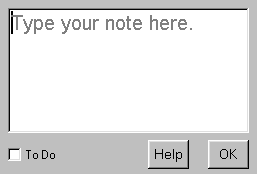
The consumer could check the "To Do" box to give the note a special "here is something I have to do" status. The note icon would be a little different:
*
Ask Lauren about the stereo - need more than 4 speakers?
The notes list page would highlight To Dos, perhaps listing them before the regular notes.
Source List
Another simple technique is to help consumers create their own information source list. For example, an auto manufacturer's Web site might have a links page for the La Bamba, an entry-level coupe. It could have links to sites relevant to the La Bamba purchase decision:
The site could also let consumers enter their own sources in the left-hand column. They need not be Web sites, although they could be.
Remember that a source's credibility depends on expertise and trust. Consider this when making up the source list. Include sources that may have low perceived expertise if they are trustworthy. Try to have at least one expert and one trustworthy source in each part of the list. A trustworthy expert source is the best of all. An example for a manufactured homes site would be a consumer who happens to also be a building inspector.
Worksheet
A worksheet is a consumer's record of their decision. It's based on a choice method, as we talked about earlier. Worksheets are stored on the server, and anything a consumer enters is remembered from session to session. Product-specific worksheets will be more useful to consumers than generic worksheets, because they take into account the attributes of a particular product.
Here is an example. Remember the choice method for manufactured housing. It had four steps: (1) work out an affordable monthly payment, (2) find a location, (3) choose a floor plan, and (4) decide on style and optional features. A worksheet would help guide consumers through each step. It might have 5 pages. The first is a general guide, with summary notes for each step:
| Step | Your Comments (click to change) |
| 1. Work out your monthly payment | We can afford about $350 a month. |
| 2. Find a location | We like the Lakes Edge Park - Tim and Kerry live there. |
| 3. Choose a floor plan | Click to enter a note |
| 4. Decide on style and optional features | Click to enter a note |
Each step has its own page, like this:
For some products, it's particularly important that consumers understand their decision criteria, that is, the things that are important to them in solving their problem. An example in the manufactured housing industry is location. Everyone knows what a monthly payment is, and why it's important. Location is different. Consumers often don't know what they want or how to measure it. Do they want good schools? What does "good schools" mean, anyway? Do they want "close to amenities?" What is "close?" What are "amenities?"
A good sales rep will help consumers understand these things. A Web site can, too. For example, the site could explain factors that people often consider when choosing a location, then let consumers record their preferences:
| Step | Your Comments (click to change) |
| 1. Work out your monthly payment | We can afford about $350 a month. |
| 2. Find a location | |
|
Other kids for Jason to play with, near the factory, near a lake. |
|
We like Lakes Edge Park - Tim and Kerry live there. |
| 3. Choose a floor plan | Click to enter a note |
|
Click to enter a note |
|
Click to enter a note |
| 4. Decide on style and optional features | |
|
Click to enter a note |
|
Click to enter a note |
Finally, the worksheet could contain links to products the consumer is thinking about (the consumer's consideration set). The consumer could add and drop products from this list:
The floor plans I am thinking about are:
The site could offer suggestions for different market segments. For example, two of the most important market segments in manufactured housing are young families and retired couples. The floor plan page might include:
We've put together a list of plans our customers like. Click the list you'd like to see:
Young families
Retired couples
Consumers could add products to their consideration set from this list:
These lists are more likely to be used early in product selection when consumers are looking for guidance.
Remember that consumers use attribute-based strategies first and then switch to brand-based strategies. Product descriptions could include lists of specific attributes important to consumers. It would be easier for consumers to run down the attribute list and select brands that interest them.
Notification of Product Changes
Products change all the time. A consumer might look at a product in week 1 and go to buy it in week 3, only to find that it changed in week 2.
One solution is to let consumers request email news about products. They could check a box on a product page, or request information about changes to products in their consideration set. Another possibility is to report products changes on the consumer's worksheet. For example, when they retrieve their worksheet, the site highlights products in their consideration set that have changed.
Implementation
Obviously, implementing these ideas would require some work. However, with a database, ASP, some JavaScript and a bit of ingenuity, many of the these features can be added fairly easily.
The main implementation challenges are behavioral, not technical. First, can the Web designers make the site easy enough to use? This requires careful development and testing with live consumers.
Second, how will individual consumers be identified? The obvious choice is to use cookies, but many people don't like them. Some consumers will type in a user name and password, but many will not. Another idea is to ask questions that create a unique key without identifying an individual. Here's an example:
Third, would consumers trust the firm enough to enter any information? Consumer-oriented sites (like Consumer Reports) or independent information intermediaries (like CarPoint) will find it easier than firms that sell their own products. All should offer confidentiality guarantees, and promise not to use the information to target obnoxious marketing campaigns at specific individuals. Even better, the site itself should not request any identifying information. Of course, consumers always have the option of checking a box that says "Have a sales representative call," but this is the consumer's choice, not the firm's.
Conclusion
The big question is: Would consumers use these features?
People tend to voluntarily use information systems that are (1) useful and (2) easy to use (see, for example, Davis, 1989). Usefulness dominates. Consumers might use the features when:
Don't expect anyone to get excited about a worksheet for choosing the right soda for a picnic. However, a worksheet for choosing a complex, expensive product like a manufactured home could have some value.
This is a work-in-progress. It will continue to evolve, as we understand more about how people use the Internet. If you have feedback, or some experiences you want to share, please send email to Kieran Mathieson at mathieso@oakland.edu.
References
Fred Davis, "Perceived Usefulness, Perceived Ease of Use, and End User Acceptance of Information Technology," MIS Quarterly, 13, 1989, 318-339.
Kieran Mathieson, "The Product Inference Lens: A Technique for Designing Marketing Web Sites," WebProfession, 1 (4), March 1998, http://www.webprofession.com/.
Michael L. Ursic and James G. Helgeson, "The Impact of Choice Phase and Task Complexity on Consumer Decision Making," Journal of Business Research, 21, 1990, 69-90.